Transition to Adult Services
When your child turns 18, not only is it a time for celebration but also for many families a time of some anxiety. There will be change from the well-known Children’s Services, many of which are delivered in an integrated way through school, to Adult Services, which are less familiar. This guide is intended to support you to understand the process, and to explain some of the systems that you will encounter as parents to young adults with complex needs.
The buttons below explain the process through each academic year in a simplified format, and the rest of this page explains it in more depth. Please do get in touch with us at school or with your child’s social worker if you need any more information about any of this.
More details about Transition Plans
Island Planning
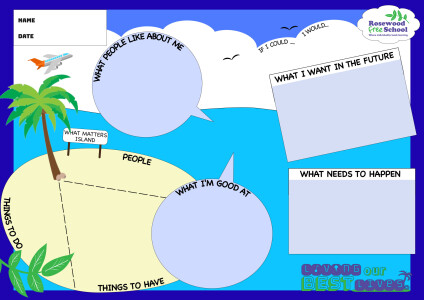
Our ‘What Matters’ island plans during Annual Reviews should help you to consider everything that is important to your child or young person.
Care and Support Assessments
All young people with SEND are eligible for a Care and Support Assessment to see what elements of care and support their family will be able to provide, and which the local authority will provide. Providing care for someone who is over 18 is a choice, and is not compulsory.
In Southampton the assessments are carried out by a team of social workers called ‘Preparing for Adulthood’, and in Hampshire the team is called ‘Independent Futures’.
Usually your child’s social worker will request this assessment to be started, but sometimes school can make a referral to this team.
The outcomes of these assessments will determine how each young person’s Care and Support plan will be funded. This may be fully by Social Care, or by Continuing Health, or a combination of both, depending on your child’s needs.
What are my child’s options after Rosewood?
There are some considerations to make when deciding about what comes next.
Firstly – should they continue in Education? If this is important for your young person, it should be agreed that their EHCP continues and an educational place found for them. There are now very few options in the area local to Southampton and so families may need to look at a residential college further afield. Please see our Destinations page for some more information to look at.
Other decisions will need to be made in collaboration with your young person’s case managers. Families need to think about these types of issues:
- Will my young person continue to live at home? If so, who will be providing for their care needs?
- What would my young person like to do with their time?
- Is it important to my young person to be in one familiar setting or would they prefer multiple opportunities?
- Is it important to my young person to have time with familiar peers
- Does my young person need a consistent enabler (or team of enablers) to support them?
- What equipment do they access at school, and can this be provided at home?
- How much support is needed for their health needs and how will this be provided?
- Will my young person need transport?
- How will their options affect my/our own finances?
Please see our Signposting information about Destinations or ask us about other ways that care and support can work for your young person.
Further Information
Making Decisions
Being able to safely make decisions about finances, benefits and care is called having ‘mental capacity’. In legal terms, this starts at age 16, and your child's social worker is likely to need to carry out a Mental Capacity Act assessment to determine whether they can make decisions for themselves or not. If your child does not have mental capacity for making a specific decision, others will need to make these decisions for them. At age 16-17 this is usually the parents who have parental responsibility.
In order to continue making decisions on your young person’s behalf after they turn 18, you will need a legal document that gives you this power – it is called a Deputyship and can be applied for from the Court of Protection. If there is no legal deputyship in place, then decisions about a young person who does not have mental capacity will be made by the team around them (including their family) in their best interests. Being your child’s carer or next of kin does not automatically give you the right to make decisions on their behalf.
Money and Finances
Banks
You will need a bank account in your child’s name for when they become an adult at 18. You can apply to manage the account but any money or benefits that they receive will have to be paid into an account in their name. Visit this Guide to Managing Money for Someone Else for more information.
Benefits
Personal Independence Payment (PIP) is a benefit to help with the extra costs of disability for people aged 16 to pension age. Click here for more information on PIP: Personal Independence Payment
If your child is already getting Disability Living Allowance (DLA) it won’t automatically stop when they reach 16. The Department for Work and Pensions will write and invite them to claim PIP, usually shortly before their 16th birthday. Their DLA will continue until a decision has been made on their PIP claim, provided they claim within the time limit.
PIP consists of a mobility component and a daily living (care) component which are paid at different rates. Your child may qualify for only one component or both together. To be eligible for PIP they must have had mobility problems or difficulty with everyday tasks for 3 months and expect it to continue for at least a further 9 months (unless they are terminally ill).
PIP claimed for your child does not depend on your household income or savings or their own personal income or savings. They can claim it regardless of whether you or they are working or how much you or they have in savings. You or they can also move in and out of work and/or education without it affecting their eligibility.
PIP is a complex benefit, and it is advisable to get specialist advice because the claim forms are long. Citizens Advice have a guide to filling in the claim form on their website. It can be helpful to keep a diary in the week or month before you complete the form to help you remember all the ways your child’s condition affects them.
Contact can help you with any questions you have about benefits for a disabled child. Your local Citizens Advice may be able to help fill in forms, or there may be a local disabled persons’ or carers’ organisation which can help. You can search for a local advice organisation on Advice Local. Scope may also be able to help you find organisations local to you who can help with claim forms.
Paying for care
Adults are normally expected to pay for some of their social care, depending on their individual circumstances. If your child has complex health needs the Integrated Care Board (ICB) may pay for this care. This is type of funded care is called NHS continuing healthcare.
Young people who are eligible for NHS continuing healthcare will get a continuing care package to help them move into adult services.
Direct Payments or Personal Health Budgets
These are a way of managing and paying for care funded by your local authority or health authority. They may give you and your child more choice on how they manage their care but can mean more work and responsibility. You and your child do not have to manage a personal budget if you do not want to. You can choose for the local authority to manage your child’s social care.
Managing your social care direct payments budget
Mobility vehicles funded through DVLA
You may be used to using the vehicle that is funded by the DVLA as a family car and using it to meet the needs of the wider family. When a young person turns 18, there is an expectation that the vehicle is primarily available to meet the needs of the young person and to provide transport to access appointments and day services / community activities.